
The plan
The core moves from the surgeons' program
These are from the AAOS rotator cuff and shoulder conditioning program, with the sets and frequency it gives. Use a band or light dumbbell, move slowly, and stop if anything hurts.
01
Standing row
3 sets of 8, 3 days a week
Band anchored to a door. Elbow bent at your side, pull it straight back and squeeze the shoulder blades together.
02
External rotation, standing
3 sets of 8, 3 days a week
Elbow bent and held against your side. Rotate the forearm outward, then return slowly.
03
Internal rotation, standing
3 sets of 8, 3 days a week
Elbow pressed into your side. Bring the forearm across your body, then return slowly.
04
External rotation with arm raised to 90 degrees
3 sets of 8, 3 days a week
Elbow bent 90 degrees and raised to shoulder height. Raise the hand toward your head, keeping the elbow level.
05
Bent-over horizontal abduction
3 sets of 8, 3 days a week
Lie face down with the arm hanging off a bench or bed. Keep it straight, raise it to eye level, lower slowly. AAOS goes up to about 5 pounds.
06
External rotation, lying on your side
2 sets of 10, 3 days a week
On your side, elbow bent 90 degrees against your ribs. Raise the weight to vertical, lower over a count of 5. Start at 1 to 2 pounds.
07
Scapula setting
10 reps, 3 days a week
Face down, gently draw the shoulder blades down and together, ease halfway out, hold 10 seconds. Keep the neck relaxed.
08
Crossover arm stretch
4 reps each side, 5 to 6 days a week
Pull one arm across the chest at the upper arm, not the elbow. Hold 30 seconds, relax 30 seconds.
What the rotator cuff does
The rotator cuff is a group of four muscles whose tendons wrap the head of the upper arm bone. It keeps the arm seated in the shoulder socket and helps you lift and rotate it, per the American Academy of Orthopaedic Surgeons (AAOS).
Pressing and pulling both depend on a shoulder that stays seated in its socket. That is the cuff's job.
Why it matters more after 40
Most rotator cuff tears come from the tendon wearing down slowly over time, and AAOS puts people over 40 at greater risk. Blood supply to the tendon falls with age, which weakens its ability to repair. Repetitive overhead work, in sports and on the job, adds stress.
Wear is often silent. Yamamoto and colleagues scanned 1,366 shoulders in a Japanese village in 2010 and found full-thickness tears in 20.7% of them. 16.9% of people with no shoulder symptoms had one. Tears were more common with age, in men, and in the dominant arm.
That is one village, not a national rate. It does show that a shoulder can feel fine and still be worn.
How to fit the program around your lifting
AAOS suggests warming up for 5 to 10 minutes first, with walking or a stationary bike, then stretching before the strength work and again at the end.
Run the program for 4 to 6 weeks, then keep it going 2 to 3 days a week to hold your strength and range of motion. AAOS describes it as something you can keep for life.
Use light resistance: AAOS uses an elastic band anchored to a door for the standing moves and starts side-lying external rotation at about 1 to 2 pounds. Move slowly, and go up in small steps only as an exercise gets easier.
The rule that matters most: you should not feel pain during any exercise. If you do, stop and talk to your doctor or a physical therapist. AAOS also recommends doing the program under a doctor's supervision, which is worth doing if your shoulder already hurts.
If your shoulder already hurts
Exercise is the first-line treatment for many worn cuffs. AAOS says nonsurgical treatment relieves pain and improves function in about 80 to 85% of patients.
Kuhn and colleagues followed 452 people with full-thickness tears that came on without an injury. A structured physical therapy program was effective for about 75% of them over two years, and fewer than 25% chose surgery.
In a 2014 randomised trial by Kukkonen and colleagues, 180 shoulders in people over 55 with this kind of tear got physiotherapy alone or surgery plus physiotherapy. At one year, the groups did the same. The authors suggest trying conservative treatment first.
Both studies were in people who already had tears. They show that the cuff responds to exercise. They do not mean you can skip a doctor's assessment of a painful shoulder.
The NHS self-care advice: keep moving the shoulder gently, do not stop using it completely, avoid what makes it worse, and do not make up your own strenuous exercises or use heavy gym equipment while it hurts.
When to see a doctor
The NHS says to see a doctor if shoulder pain is getting worse or does not improve after 2 weeks, or if it is very difficult to move your arm or shoulder. AAOS lists pain at rest and at night, especially lying on that side, and weakness when lifting or rotating the arm as common signs of a tear.
Get urgent help if any of these apply, per the NHS:
- Sudden or very bad shoulder pain
- You cannot move your arm
- Your arm or shoulder has changed shape or is badly swollen
- Pins and needles that do not go away, or no feeling in your arm or shoulder
- Your arm or shoulder is hot or cold to touch
- The pain started after an injury or accident, like a fall
- Severe pain in both shoulders, or you feel feverish or unwell
Fit check
Who this guide is (and is not) for
Good fit
- Men over 40 who press, pull, or play overhead sports and want to keep their shoulders working.
- Men coming back to lifting after a layoff who want a shoulder routine before adding load.
- Men with a mildly cranky shoulder who have been told by a clinician that exercise is the plan.
Poor fit
- Anyone with sudden severe pain, an arm you cannot lift, or pain after a fall. See a doctor first.
- Anyone in the first weeks after shoulder surgery. Follow your surgeon's protocol.
- Anyone whose shoulder hurts during these exercises. Stop and get it assessed.
Common questions
The questions worth answering
How often should I do rotator cuff exercises?
The AAOS program runs 4 to 6 weeks, with most strengthening moves 3 days a week, then 2 to 3 days a week to maintain. Warm up first, and stop any exercise that hurts.
How heavy should rotator cuff exercises be?
Light. The AAOS program starts side-lying external rotation at about 1 to 2 pounds and uses bands of comfortable resistance for the standing moves. Go up in small steps as an exercise gets easier, and never into pain.
Can a rotator cuff tear heal with exercise?
Many tears that came on without an injury improve with physical therapy. In one study of 452 patients, therapy was effective for about 75% over two years. A doctor should assess a painful shoulder first.
Do I have a rotator cuff tear if my shoulder hurts at night?
AAOS lists pain at rest and at night, and weakness lifting or rotating the arm, as common signs of a tear. A doctor can examine you and decide on imaging. Symptoms alone are not a diagnosis.
Should I keep lifting with shoulder pain?
The NHS says keep the shoulder moving gently, but avoid what makes it worse and skip heavy gym equipment while it hurts. See a doctor if it is not better in 2 weeks.
Muscle Velocity standard
Healthy shoulders keep you training
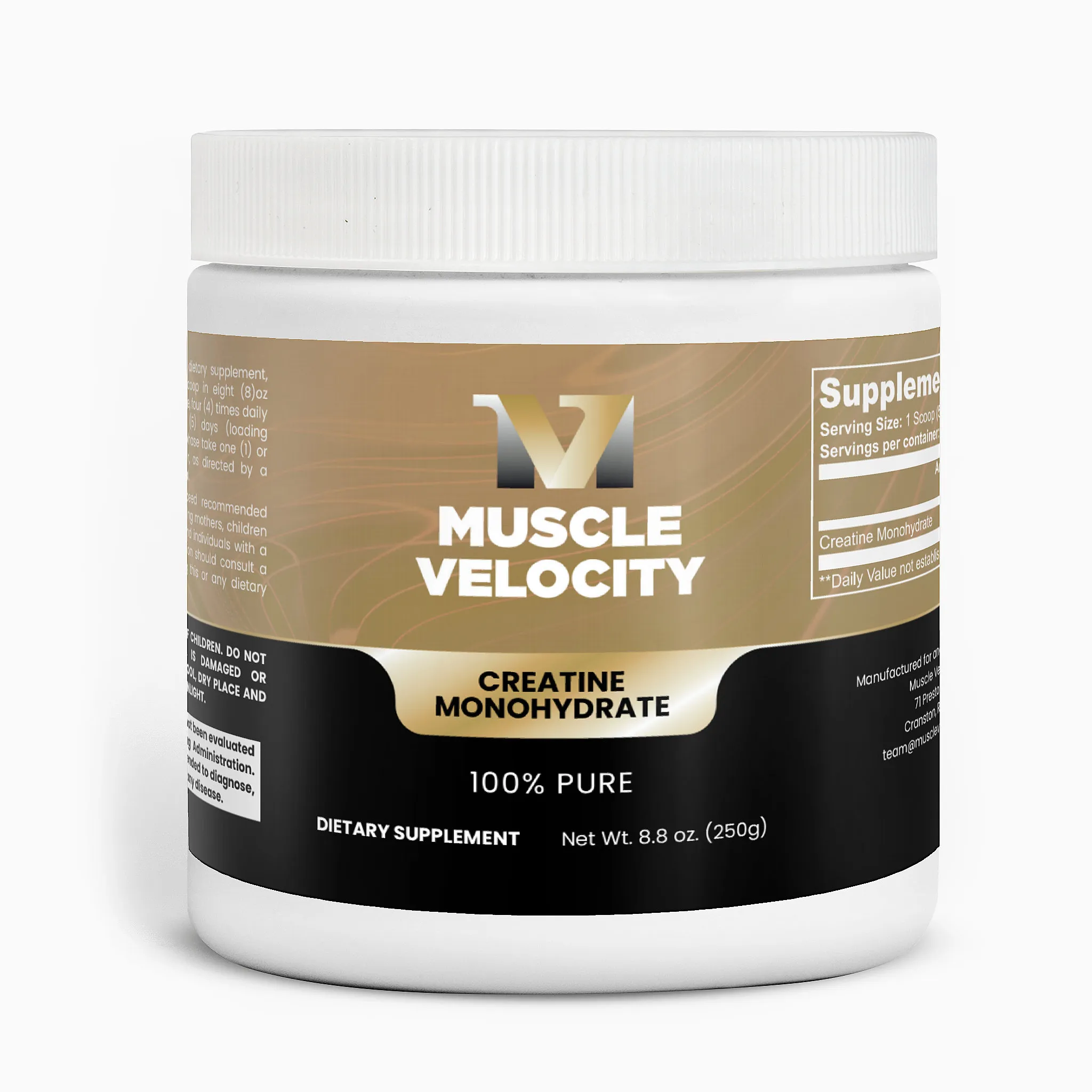
The cuff work keeps the joint ready for the big lifts. If you want a simple, well-studied supplement for the training itself, creatine monohydrate is ours. It supports training; it does nothing specific for tendons.
Simplest protocol
Creatine Monohydrate
Single-ingredient micronized monohydrate for a straightforward daily creatine routine.
View creatine monohydrateEducational content only, not a diagnosis or a treatment plan. Speak with a doctor or physical therapist about shoulder pain, an injury, or a recent surgery before starting these exercises.
Evidence desk