
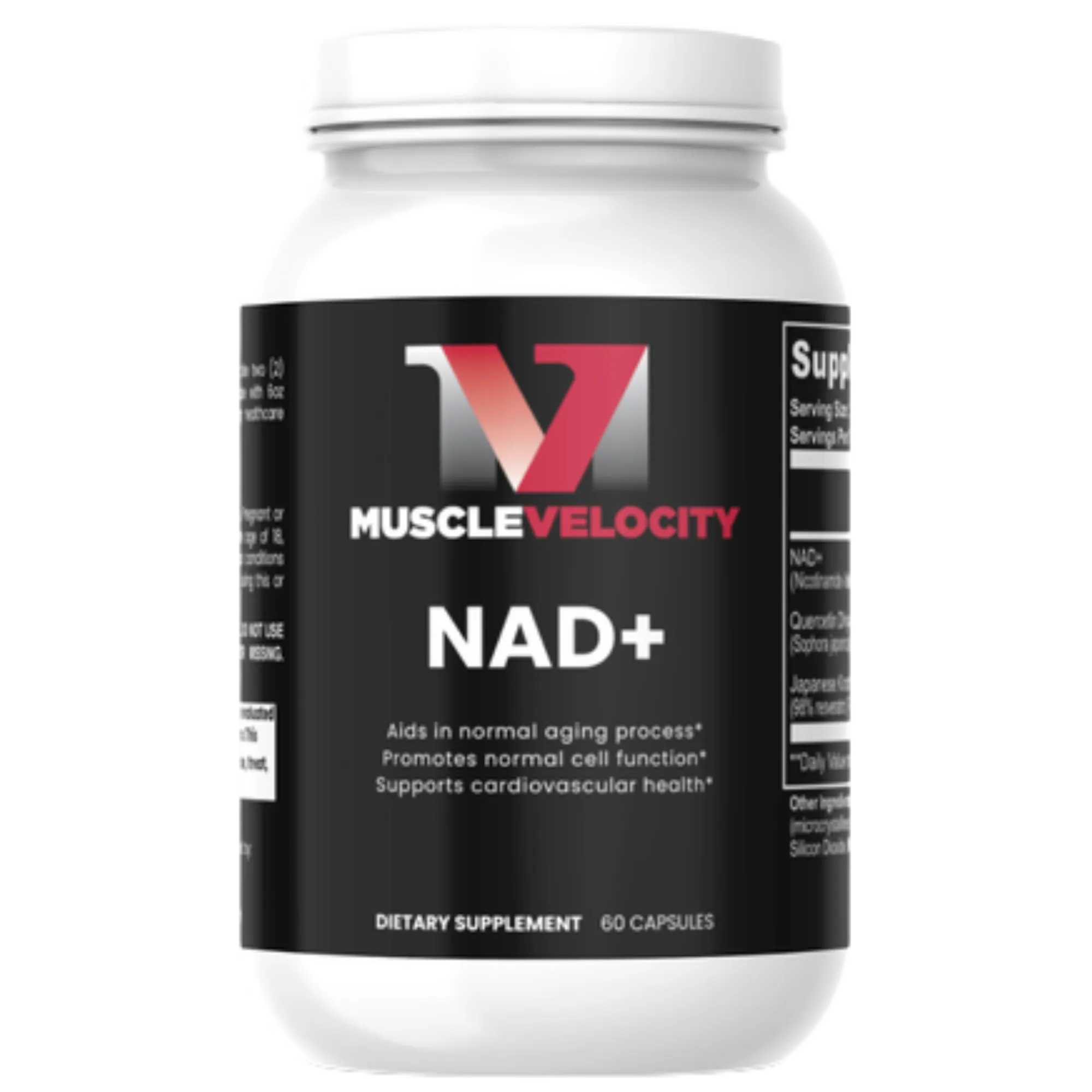
Daily cellular protocol
NAD+
500mg of NAD+ supported by Quercetin and Resveratrol, dosed once daily for cellular energy and metabolic health.
View NAD+Timing, honestly
There is a confident answer all over the internet. There is not a trial behind it. Here is the difference between the two.
This guide is part of our NAD+ supplement guides track. For continuity, read our NAD+ daily protocol and NAD+ purity and quality.
The short answer
No randomized trial has tested NAD+ dosing time as a variable. The studies that define this field used consistent daily dosing — Martens and colleagues split 1000mg of nicotinamide riboside into 500mg twice daily, and the pooled NMN trials used steady daily amounts across four to twelve weeks. Morning dosing is commonly recommended on the basis that NAD+ follows a circadian pattern, which is reasonable mechanistic thinking but not a tested finding. Consistency is the part that actually has support.
Decision brief
No trial in this field randomized participants to different dosing times.
The evidence base used consistent daily dosing over four to twelve weeks.
Morning-dosing advice rests on circadian reasoning, not on a timing trial.
Taking it at the same time daily is the part that makes your own results interpretable.
Muscle Velocity standard
500mg of NAD+ with Quercetin and Resveratrol in a single daily serving. Easy to attach to a morning routine and hold steady for eight weeks.
Daily cellular protocol
500mg of NAD+ supported by Quercetin and Resveratrol, dosed once daily for cellular energy and metabolic health.
View NAD+Educational content only. Supplements are not a substitute for medical care. Speak with a qualified healthcare professional when a condition, medication, or persistent symptom is involved.
Martens and colleagues dosed 500mg of nicotinamide riboside twice daily across two six-week arms in a double-blind placebo-controlled crossover. The design tested the compound against placebo, not one schedule against another.
The NMN trials pooled in the 2024 performance review — ten randomized studies, 437 participants — used daily doses between 150mg and 1200mg. The 2024 metabolic meta-analysis covered eight trials at 250–2000mg/day. Neither review reports timing as an examined variable, because the underlying trials did not treat it as one.
So when a source tells you confidently that morning is optimal, ask what it is citing. The honest answer is that the question has not been put to a trial.
NAD+ levels follow a circadian pattern, and the enzymes that consume and regenerate it are tied into daily metabolic rhythms. Dosing in the morning to align with that is coherent reasoning, and there is no particular reason to argue against it.
It is also practically sensible. A supplement attached to an existing morning routine gets taken. One that depends on remembering something at an unusual hour does not, and adherence is the variable that most often decides whether a personal trial produces a usable answer.
What it is not is a finding. Mechanistic reasoning and a tested result are different categories of claim, and this field has a habit of blurring them.
On food: trials have not established a requirement either way. Taking it with a meal is a common approach and helps some people avoid mild stomach discomfort. If you tolerate it fasted, nothing in the literature argues against that.
On splitting: the Martens trial split 1000mg into two 500mg doses. Other trials used single daily doses. Both approaches raised NAD+, so splitting is an option rather than a requirement, and matters mostly for tolerability at higher amounts.
On cycling: there is no trial evidence supporting a cycling protocol. Recommendations to cycle on and off are inventions of the supplement conversation, not findings. If you are going to run a trial, run it continuously so the result means something.
Buying checklist
Adherence beats theoretical optimisation. Attach the dose to something you already do daily.
Consistency is what makes an eight-week personal trial interpretable. Variable timing adds noise for no benefit.
If a split dose suits you better, choose a product whose serving size makes that straightforward.
Anyone stating an optimal hour is reasoning, not citing. Treat it accordingly.
Fit check
Common questions
No randomized trial has tested dosing time as a variable, so there is no evidence-based optimal hour. Morning is commonly recommended because NAD+ follows a circadian pattern, which is reasonable mechanistic thinking. Consistency matters more than the specific time.
Trials have not established a requirement either way. Taking it with a meal is common and can reduce mild stomach discomfort. If you tolerate it fasted, nothing in the literature argues against that.
The Martens trial split 1000mg of nicotinamide riboside into two 500mg doses, while other trials used a single daily dose. Both raised NAD+. Splitting is an option that mainly helps tolerability at higher amounts rather than a requirement.
There is no trial evidence supporting a cycling protocol. Published studies dosed continuously for four to twelve weeks. If you want to judge whether it does anything for you, run it continuously rather than introducing a variable nobody has tested.
Evidence desk
Continue the NAD+ guide
Dose, timing, and how to verify a label before you pay for it.
All NAD+ guides