
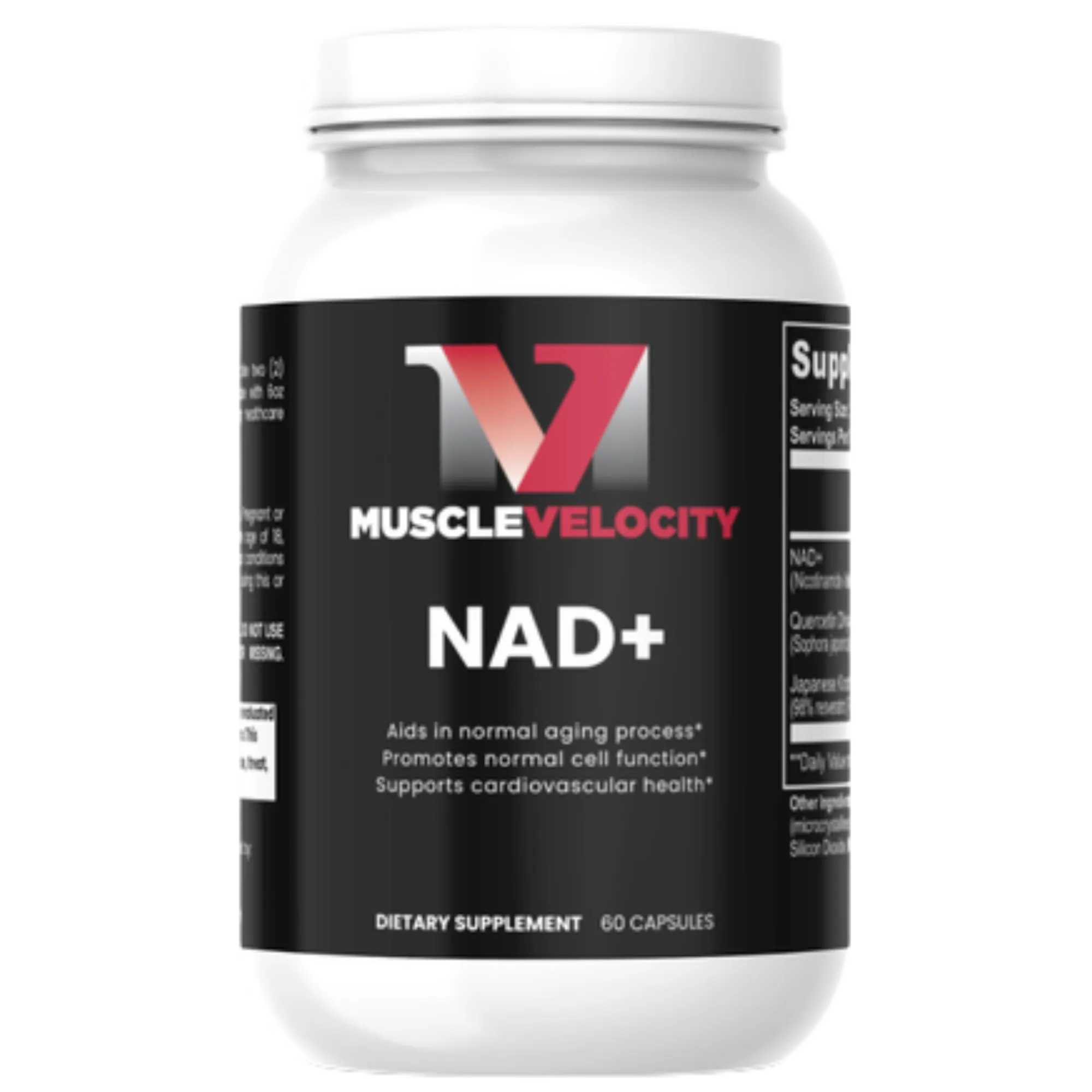
Daily cellular protocol
NAD+
500mg of NAD+ supported by Quercetin and Resveratrol, dosed once daily for cellular energy and metabolic health.
View NAD+Longevity, carefully
This is the claim the entire category is built on. Half of it is well documented. The other half has never been demonstrated in a person.
This guide is part of our NAD+ supplement guides track. For continuity, read our NAD+ longevity formula and NAD+ for men.
The short answer
NAD+ declines with age in human tissue — Massudi and colleagues measured it directly in skin from donors aged 0 to 77 and found a strong negative correlation. Oral precursors reliably restore circulating NAD+, with Martens and colleagues showing roughly a 60% rise at 1000mg/day of nicotinamide riboside. What has never been demonstrated is that raising NAD+ extends human lifespan or reverses ageing. The first two claims are evidence. The third is the marketing.
Decision brief
The age-related NAD+ decline is measured in human tissue, not just modelled.
Oral precursors reliably restore circulating NAD+ in randomized trials.
No human trial has demonstrated that this extends lifespan or reverses ageing.
Trial outcome measures — strength, metabolism, body composition — have largely come back null.
Muscle Velocity standard
500mg of NAD+ with Quercetin and Resveratrol. We will tell you the decline is measured and the reversal is not — then let you decide.
Daily cellular protocol
500mg of NAD+ supported by Quercetin and Resveratrol, dosed once daily for cellular energy and metabolic health.
View NAD+Educational content only. Supplements are not a substitute for medical care. Speak with a qualified healthcare professional when a condition, medication, or persistent symptom is involved.
Massudi and colleagues sampled non-sun-exposed skin from 49 donors ranging from newborn to 77 years old and found a strong negative correlation between NAD+ and age: r = −0.706 in males and r = −0.537 in females. They described it as the first demonstration that NAD+ declines with age in human tissue.
They connected it to PARP activity. PARPs consume NAD+ while repairing DNA damage, and oxidative damage accumulates over a lifetime, so more of the available NAD+ is spent on repair as you get older.
That is a coherent, measured account of why the molecule becomes scarcer. It is a genuinely good reason to find the category interesting.
Restoring the biomarker is achievable. The Martens crossover — thirty adults aged 55–79, double-blind, placebo-controlled — raised NAD+ in peripheral blood mononuclear cells roughly 60% at 1000mg/day of nicotinamide riboside. That trial also found blood pressure and arterial stiffness improvements that did not survive statistical correction.
What follows from restoring it is where the field goes quiet. A 2024 meta-analysis of eight NMN trials in 342 adults found no significant change in glucose, insulin, HbA1c, lipids, BMI, or blood pressure. A 2024 review of ten performance trials found strength and aerobic improvements described as nonsignificant.
No human trial has tested lifespan, because a human lifespan trial is not a practical study design. Any product implying otherwise is selling a rodent result with a human photograph attached.
The reasonable position is that NAD+ decline is a real feature of ageing biology, that supplementation demonstrably addresses the biomarker, and that whether this matters for how you age is unresolved. You can find that worth a modest monthly spend without believing anything unproven.
What you should not do is let it displace the interventions that do have ageing evidence: resistance training, sleep, protein intake, cardiovascular fitness, and not smoking. Those are not glamorous and they are not in a bottle, and they outrank everything in this category.
Gindri and colleagues reviewed NAD and its precursors across ten studies and 489 participants in varied clinical populations and found them well tolerated. Well tolerated is a reason it is reasonable to try. It is not a reason to expect a transformation.
Buying checklist
No human trial has tested either. A product making the claim is telling you what it thinks you will believe.
Much of the longevity story in this category comes from animal work. Check which species a cited result came from.
150–2000mg/day covers the published trials depending on precursor and outcome measured.
Restoring a declining coenzyme is defensible. Restoring youth is not a claim anyone can currently support.
Fit check
Common questions
Yes, and it has been measured directly in human tissue. Massudi and colleagues sampled skin from 49 donors aged 0 to 77 and found a strong negative correlation with age, r = −0.706 in males and r = −0.537 in females.
No human trial has demonstrated that. Supplementation reliably restores circulating NAD+, but trials measuring downstream outcomes — metabolic markers, strength, body composition — have largely returned null results. Lifespan has never been tested in humans.
No trial has established an optimal starting age. The randomized studies mostly enrolled middle-aged and older adults, with the Martens crossover recruiting people aged 55 to 79. That tells you where the evidence was gathered, not when you should begin.
Gindri and colleagues reviewed ten studies covering 489 participants across varied clinical conditions and found NAD and its precursors well tolerated, and a 2024 NMN review reported no serious adverse effects. Those are short trials, so they support short-term safety rather than open-ended reassurance.
Evidence desk
Continue the NAD+ guide
What the trials support for a specific outcome — and what they do not.