
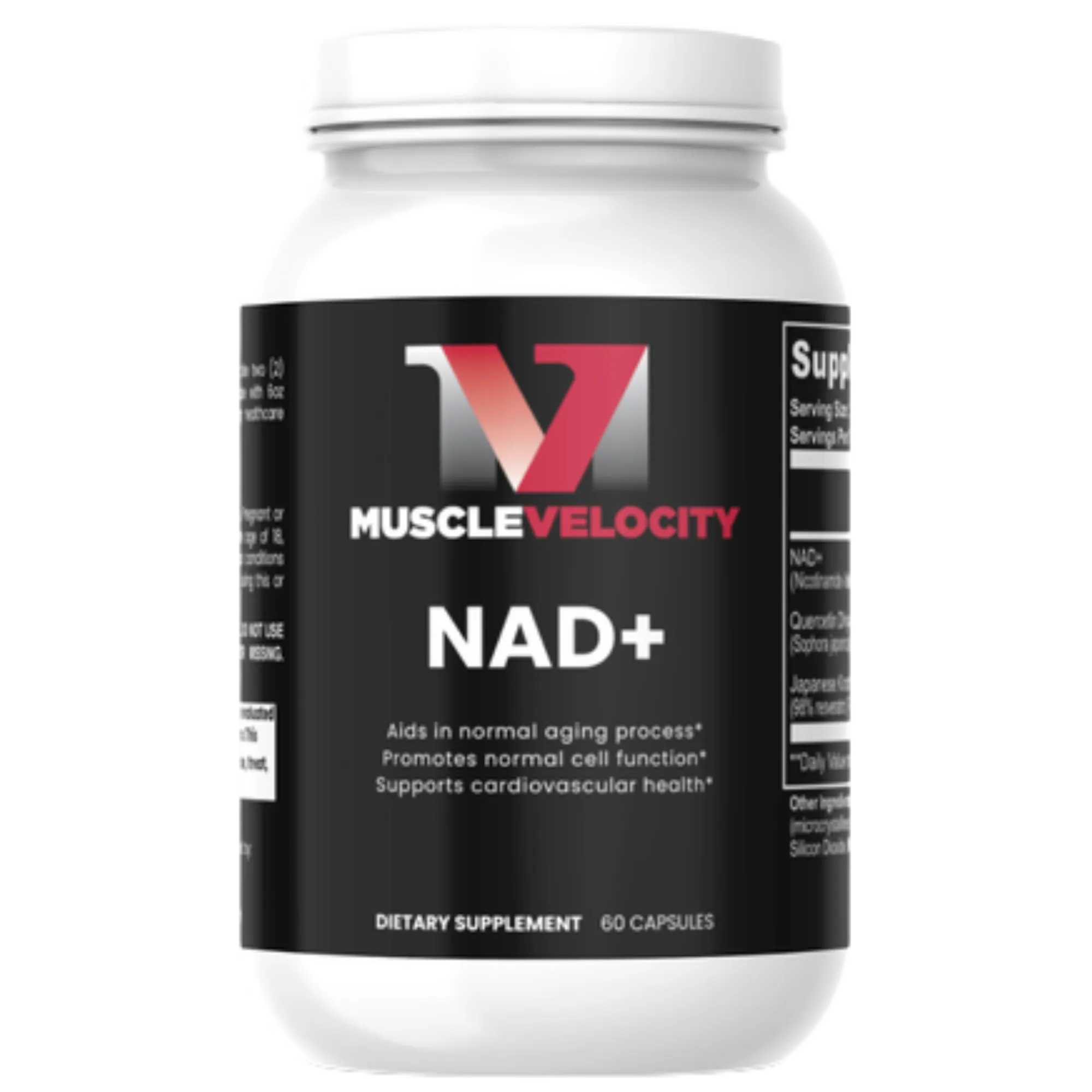
Daily cellular protocol
NAD+
500mg of NAD+ supported by Quercetin and Resveratrol, dosed once daily for cellular energy and metabolic health.
View NAD+Skin, without the before-and-after
The decline of NAD+ in human skin is documented in actual tissue. The claim that a capsule reverses how your skin looks is not.
This guide is part of our NAD+ supplement guides track. For continuity, read our NAD+ cellular formula and NAD+ for aging.
The short answer
NAD+ genuinely declines in human skin with age — Massudi and colleagues measured it in non-sun-exposed skin from 49 donors aged 0 to 77 and found a strong negative correlation with age. That is a real finding in real tissue. What does not yet exist is a body of randomized human trials showing that oral NAD+ precursors improve skin appearance or measured skin outcomes. Photoaging work exists largely in mice. Treat skin claims in this category as extrapolation, not evidence.
Decision brief
NAD+ decline in human skin is directly measured, not inferred — r = −0.706 in males.
Human trials of oral NAD+ precursors have focused on cardiovascular, metabolic, and performance endpoints.
The skin-specific photoaging research is largely preclinical, conducted in mice.
Sun protection remains the intervention with overwhelming evidence for visible skin ageing.
Muscle Velocity standard
500mg of NAD+ with Quercetin and Resveratrol for cellular energy support. No skin promises, because there is no human trial behind them.
Daily cellular protocol
500mg of NAD+ supported by Quercetin and Resveratrol, dosed once daily for cellular energy and metabolic health.
View NAD+Educational content only. Supplements are not a substitute for medical care. Speak with a qualified healthcare professional when a condition, medication, or persistent symptom is involved.
Massudi and colleagues, publishing in PLOS ONE in 2012, sampled non-sun-exposed pelvic skin from 49 donors spanning newborns to 77-year-olds. They reported a strong negative correlation between NAD+ levels and age in both males (r = −0.706, p = 0.001) and females (r = −0.537, p = 0.01).
They linked that decline to increased PARP activity responding to accumulated oxidative DNA damage — PARPs consume NAD+ as they work, so more damage means more NAD+ spent on repair.
This is the strongest part of the NAD+ and skin story, and it is worth stating precisely: the decline is documented. That is not the same as demonstrating that reversing it changes anything you can see in a mirror.
Human trials of NR and NMN have concentrated on cardiovascular, systemic metabolic, exercise, and safety endpoints. Skin appearance has not been a primary outcome in the major randomized trials that define this field.
The skin-specific research that does exist — work on barrier function and UV-B-induced photoaging — has largely been conducted in mice. Preclinical work is how good hypotheses start. It is not a basis for telling someone their skin will change.
So the honest sequence is: NAD+ falls in skin with age (measured in humans), raising blood NAD+ with oral precursors works (measured in humans), and whether the second changes the first in any way you would notice has not been established in humans.
If visible skin ageing is the concern, the intervention with overwhelming evidence is daily sun protection. Nothing in the NAD+ category comes close to that evidence base, and no supplement substitutes for it.
Beyond that, topical retinoids and basic dermatological care have far more human outcome data than oral NAD+ precursors do for skin specifically. A dermatologist is a better first spend than this aisle.
That does not make NAD+ precursors pointless — it makes skin a poor reason to buy them. Buy for cellular energy support with realistic expectations, and let skin outcomes be a bonus you have not been promised.
Buying checklist
There is no randomized human trial supporting skin-appearance claims for oral NAD+ precursors. Photos are not a substitute for one.
If a brand cites photoaging research, check whether it was conducted in mice. Most of it was.
Any product positioning itself ahead of daily SPF for visible ageing has its priorities backwards.
Buying for a different, better-supported reason still requires a stated dose and verified content.
Fit check
Common questions
NAD+ measurably declines in human skin with age, which is documented in tissue. But randomized human trials of oral NAD+ precursors have not established that supplementation improves skin appearance or structure. The skin-specific photoaging research is largely preclinical.
There is no randomized human trial supporting a wrinkle benefit from oral NAD+ precursors. For visible skin ageing, daily sun protection and topical retinoids have vastly more human evidence behind them.
Massudi and colleagues measured NAD+ in non-sun-exposed skin from 49 donors aged 0 to 77 and found a strong negative correlation with age — r = −0.706 in males and r = −0.537 in females. They attributed it partly to PARP activity consuming NAD+ during DNA repair.
Topical delivery of NAD+ precursors has not been established in human trials either. Patents and formulations exist, but the evidence base for topical application is even thinner than for oral, which is itself thin for skin outcomes.
Evidence desk
Continue the NAD+ guide
What the trials support for a specific outcome — and what they do not.