
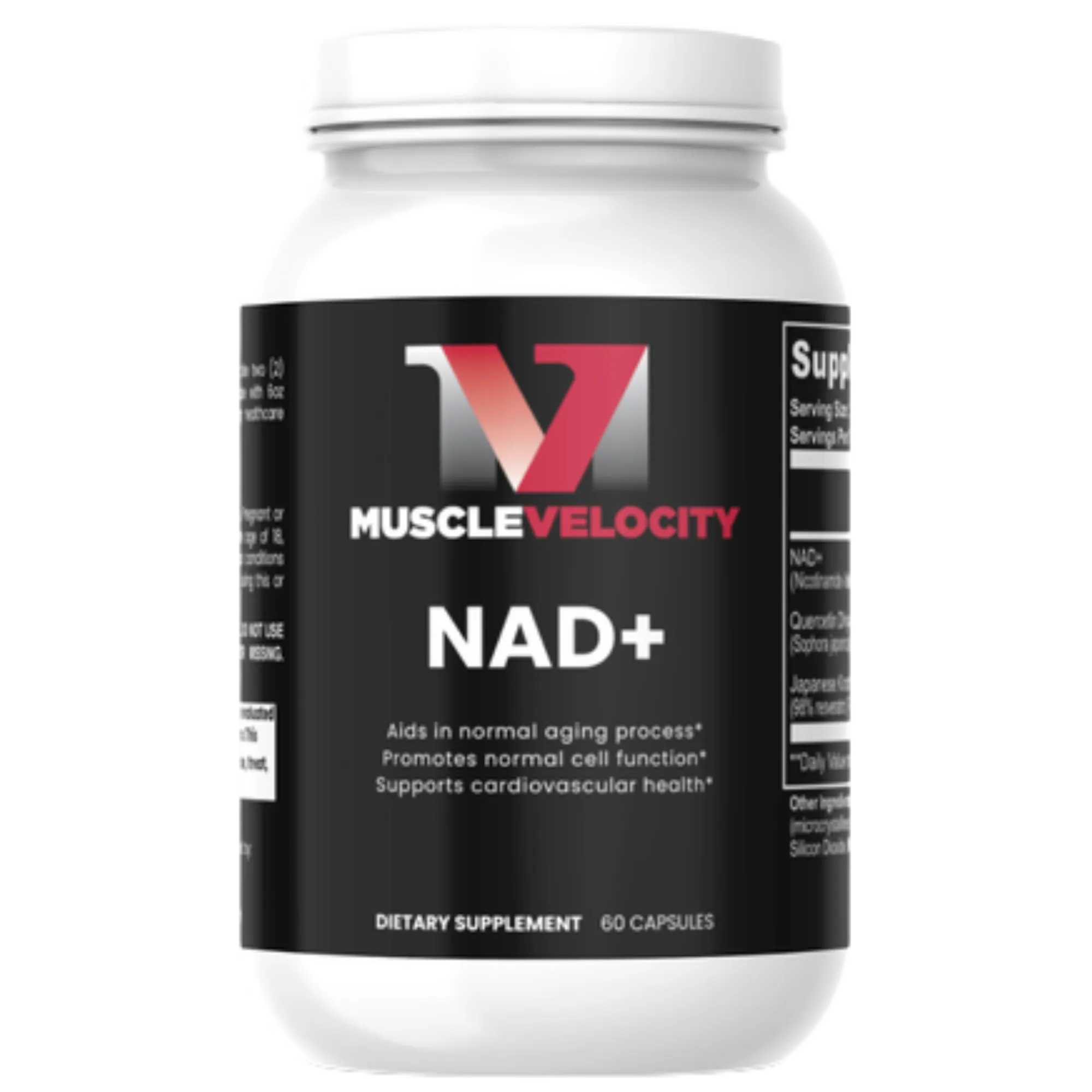
Daily cellular protocol
NAD+
500mg of NAD+ supported by Quercetin and Resveratrol, dosed once daily for cellular energy and metabolic health.
View NAD+Energy, minus the promise
NAD+ sits at the centre of how your cells make energy. That is a mechanism, not a guarantee — and the gap between the two is where most supplement marketing lives.
This guide is part of our NAD+ supplement guides track. For continuity, read our NAD+ energy formula and NAD+ booster supplements.
The short answer
Oral NAD+ precursors reliably raise NAD+ levels in the blood. Whether that raises how energetic you feel is a separate question with weaker evidence. Martens and colleagues showed 1000mg/day of nicotinamide riboside lifted NAD+ in immune cells by roughly 60% over placebo in adults aged 55–79. A 2024 systematic review of ten NMN trials found aerobic and strength measures improved only nonsignificantly. Treat NAD+ as a foundation input worth testing deliberately — not a stimulant, and not a fix for why you are tired.
Decision brief
Raising blood NAD+ is well established. Raising subjective energy is not the same claim and has thinner support.
NAD+ is not a stimulant. If a product makes you feel something within an hour, look for what else is in it.
The strongest trials ran 4–12 weeks. Judging a two-week trial tells you almost nothing.
Persistent fatigue is a medical question first — thyroid, iron, sleep apnoea, and medication effects all outrank any supplement.
Muscle Velocity standard
500mg of NAD+ with Quercetin and Resveratrol, in a stated amount, once a day. No stimulants to muddy what you are measuring.
Daily cellular protocol
500mg of NAD+ supported by Quercetin and Resveratrol, dosed once daily for cellular energy and metabolic health.
View NAD+Educational content only. Supplements are not a substitute for medical care. Speak with a qualified healthcare professional when a condition, medication, or persistent symptom is involved.
NAD+ is a coenzyme your cells use to convert fuel into ATP. It also feeds the sirtuin and PARP enzymes involved in DNA repair and metabolic signalling. Levels fall with age. Put those three facts together and you have a genuinely interesting target — which is exactly why it gets oversold.
The logic chain most ads run is: NAD+ powers cellular energy, NAD+ falls with age, therefore raising it restores your energy. The first two links hold up. The third is the one that has to be demonstrated in people, and that is where the evidence gets thinner.
This matters because you are not buying a mechanism. You are buying an outcome. The honest version is that the mechanism is real, the blood-level effect is real, and the felt-energy effect is still an open question.
The cleanest NAD+ result comes from Martens and colleagues in Nature Communications. Thirty adults aged 55–79 were randomized into a double-blind, placebo-controlled crossover design, taking 500mg of nicotinamide riboside twice daily across two six-week periods. NAD+ in peripheral blood mononuclear cells rose about 60% versus placebo. The compound does what it says on the tin.
The secondary outcomes are the instructive part. Systolic blood pressure dropped 3.9 mmHg on average — a trend that did not survive correction for multiple comparisons. Aortic stiffness moved in the right direction and also missed significance. A real, well-run trial found a clear biochemical effect and softer clinical ones.
On performance specifically, a 2024 systematic review pooled ten randomized NMN trials covering 437 participants at 150–1200mg/day. Gait speed, six-minute walking distance, and a five-times sit-to-stand test improved. Grip strength, skeletal muscle mass, and body composition did not. Its own conclusion is that NMN produces a nonsignificant improvement in physical strength and aerobic performance, while being well tolerated.
Fix the obvious inputs first. Sleep debt, untreated iron deficiency, alcohol, and a collapsing training schedule will all swamp anything a capsule does. Testing a supplement on top of a broken foundation only teaches you that the foundation was broken.
Then pick one measurable outcome before you start, not after. Afternoon focus at a fixed time. Reps at a fixed load. How you feel on the third set, not how you feel on a good day. Vague impressions are exactly what a placebo is best at producing.
Give it the length the research used — eight weeks, not eight days — at a consistent daily dose and a consistent time. If nothing moves, that is a real answer and a reason to stop paying for it.
Buying checklist
Published trials ran 150–1200mg/day. A label that hides its amount inside a proprietary blend cannot be compared to anything.
Caffeine or synephrine produce an immediate lift that makes it impossible to judge what the NAD+ is doing. If you feel it in 30 minutes, that was not the NAD+.
NAD+ precursors are a premium-priced category, which attracts underdosed products. Ask for a certificate of analysis tied to your lot number.
Any product promising to reverse ageing, cure fatigue, or guarantee a result is telling you it has not read its own research.
Fit check
Common questions
The trials that found effects ran four to twelve weeks. Blood NAD+ rises well before that, but the physical-performance measures that moved in the research were assessed over months, not days. Judge it at eight weeks on a consistent daily dose.
The blood-level effect is well established — roughly 60% in the Martens crossover trial. The felt-energy effect is much less settled. A 2024 review of ten NMN trials found aerobic and strength improvements that did not reach statistical significance, so honest framing is that it may support energy metabolism rather than that it will raise your energy.
Trials generally used consistent daily dosing rather than testing timing as a variable, so there is no strong evidence favouring either. Consistency matters more than clock time. Many people take it with a morning meal simply because it is easier to remember.
Across the studies reviewed by Gindri and colleagues, NAD+ and its precursors were well tolerated, and the 2024 NMN review reported no serious adverse effects. That is a safety signal from short trials in mostly older adults, not an unlimited endorsement. Speak with a clinician if you take prescription medication or have a diagnosed condition.
Evidence desk
Continue the NAD+ guide
What is actually in the bottle, and whether the delivery claims hold up.