
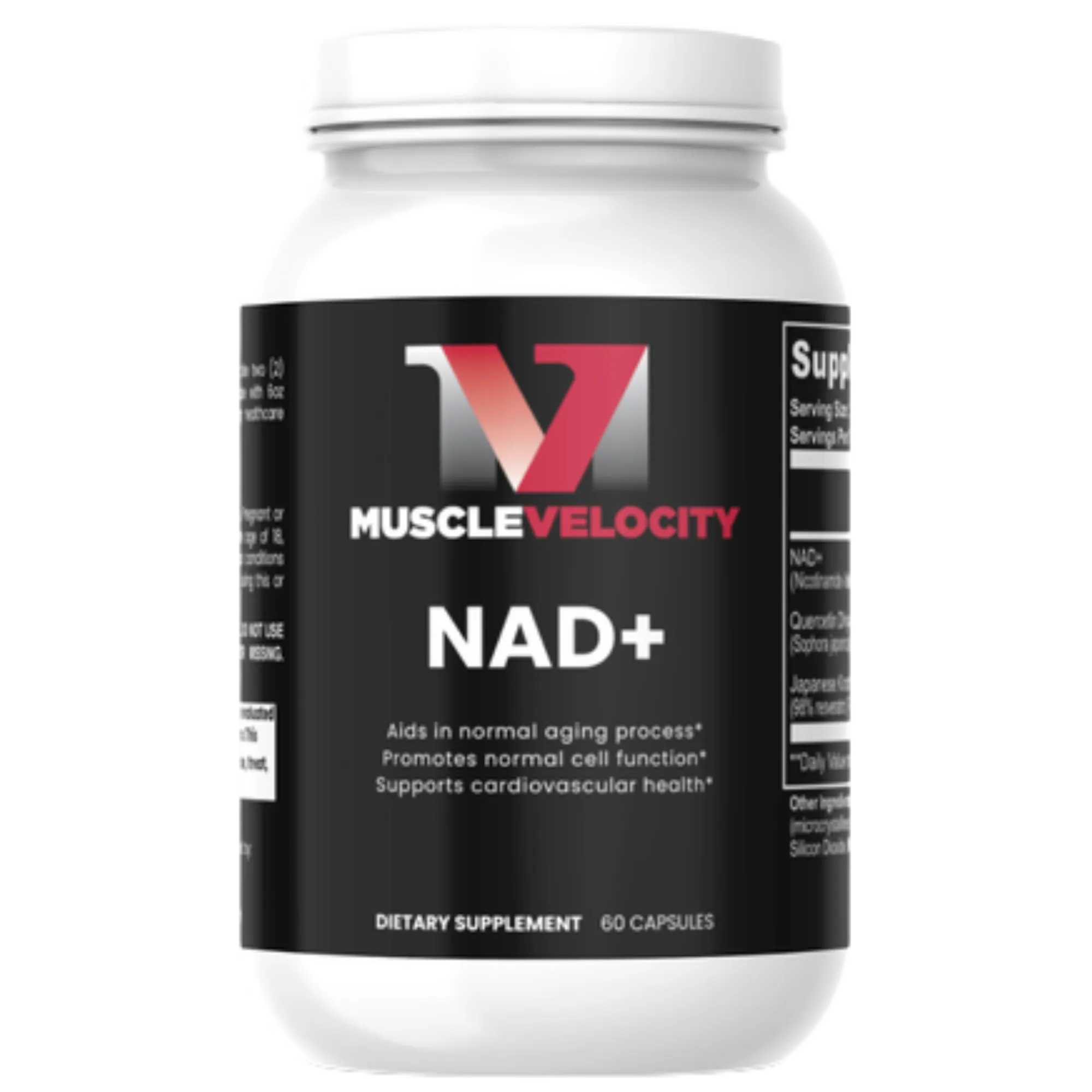
Daily cellular protocol
NAD+
500mg of NAD+ supported by Quercetin and Resveratrol, dosed once daily for cellular energy and metabolic health.
View NAD+The stack, examined
The pairing has a real biological rationale. It also has a marketing story that has travelled considerably further than the human data.
This guide is part of our NAD+ supplement guides track. For continuity, read our resveratrol-supported NAD+ and NAD+ precursor supplements.
The short answer
Sirtuins are enzymes that require NAD+ as a cofactor. Resveratrol influences sirtuin activity. Combining them is therefore mechanistically coherent — supply the cofactor, and support the enzyme that uses it. What does not yet exist is a strong body of human trials testing the combination against either compound alone. The synergy figures quoted in marketing generally come from animal work. The pairing is reasonable; the confidence attached to it usually is not.
Decision brief
NAD+ is the required cofactor for sirtuin enzymes. That part is settled biochemistry.
Resveratrol's effect on human SIRT1 has been examined in randomized trials and meta-analysis.
Direct human trials of the NAD+ and resveratrol combination remain limited.
The commonly quoted synergy multiples come from animal studies, not people.
Muscle Velocity standard
500mg of NAD+ with Quercetin and Resveratrol. A coherent stack, described as what it is rather than as a multiplier.
Daily cellular protocol
500mg of NAD+ supported by Quercetin and Resveratrol, dosed once daily for cellular energy and metabolic health.
View NAD+Educational content only. Supplements are not a substitute for medical care. Speak with a qualified healthcare professional when a condition, medication, or persistent symptom is involved.
Sirtuins are a family of enzymes involved in metabolic regulation and DNA repair. They cannot function without NAD+ — it is consumed as a cofactor every time they act. As NAD+ falls with age, the substrate those enzymes depend on becomes scarcer.
Resveratrol entered this story as a sirtuin activator. The mechanism is less direct than early coverage suggested: rather than switching SIRT1 on, it appears to stabilise interactions between the enzyme and certain substrates, and to influence NAD+ availability through AMPK signalling.
Put together, the logic is that one compound supplies the fuel and the other supports the machinery. That is a sound rationale for formulating them together. It is not, by itself, proof that the combination outperforms either alone in humans.
Resveratrol's effect on SIRT1 in people has been examined systematically, including a GRADE-assessed dose-response meta-analysis of randomized trials. That is the right place to look for whether oral resveratrol measurably changes sirtuin activity in humans, rather than in a dish.
The NAD+ side has its own trial record. Martens and colleagues showed roughly a 60% rise in NAD+ within immune cells at 1000mg/day of nicotinamide riboside, in a double-blind placebo-controlled crossover.
What is missing is the middle: well-powered human trials comparing the combination against each compound on its own. The frequently cited multiples — NAD+ levels 1.6 to 1.7 times higher in heart and skeletal muscle — come from animal work. Useful as a hypothesis. Not a human result.
The first question is whether both amounts are disclosed. Combination formulas are the easiest place to hide a token dose of the expensive ingredient behind a generous dose of the cheap one.
The second is whether the resveratrol amount is meaningful relative to what trials have used, rather than a dusting included so it can appear on the label. A blend that lists a combined total for several ingredients is telling you it would rather you did not check.
The third is what the product claims. A formulation that says the pairing is mechanistically sensible is being honest. One that quotes an animal synergy figure as though it were a human outcome is not.
Buying checklist
A combined blend total tells you nothing about how much of each compound you are actually buying.
A trace inclusion exists to justify the label. Compare against amounts used in published resveratrol trials.
The combination is mechanistically reasonable. Claims of specific multiplied benefits in humans are not supported.
Combination products are no less prone to label inaccuracy than single-ingredient ones. Ask for the lot certificate.
Fit check
Common questions
The pairing is mechanistically coherent, because sirtuins require NAD+ as a cofactor and resveratrol influences sirtuin activity. But direct human trials of the combination remain limited, and the synergy figures usually quoted come from animal studies. It is a reasonable formulation, not a proven upgrade.
It has been studied in randomized trials and pooled in a GRADE-assessed dose-response meta-analysis. The mechanism appears more indirect than early reporting suggested, involving stabilisation of enzyme-substrate interactions and effects on NAD+ availability rather than a simple on-switch.
There is no established combination dose, because the combination itself has not been well tested in humans. What you can check is whether the amount is disclosed separately and is comparable to doses used in standalone resveratrol trials, rather than hidden inside a blend total.
Quercetin is a polyphenol studied for its own signalling effects and often included alongside NAD+ precursors. As with resveratrol, the honest framing is a plausible complementary rationale rather than a demonstrated combination benefit in human trials.
Evidence desk
Continue the NAD+ guide
What is actually in the bottle, and whether the delivery claims hold up.