
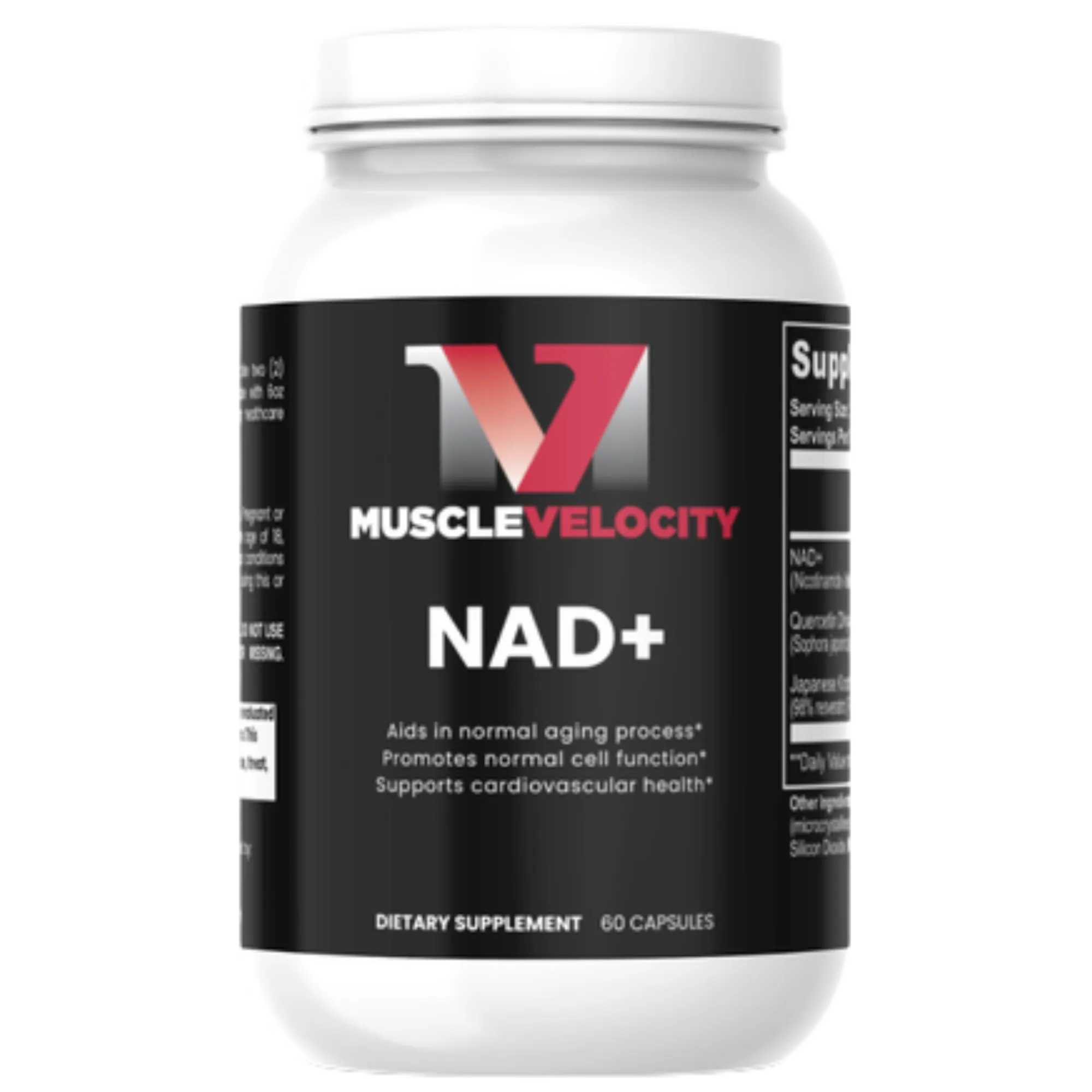
Daily cellular protocol
NAD+
500mg of NAD+ supported by Quercetin and Resveratrol, dosed once daily for cellular energy and metabolic health.
View NAD+The salvage pathway, plainly
Your body does not absorb NAD+ whole. It rebuilds it from precursors — which is why the precursor on the label is the real product.
This guide is part of our NAD+ supplement guides track. For continuity, read our NAD+ precursor blend and liposomal NAD+ supplements.
The short answer
NAD+ is regenerated through a salvage pathway that recycles smaller molecules. The three precursors sold as supplements are nicotinamide riboside, NMN, and nicotinamide. All three raise NAD+ in humans. NR has the deepest randomized trial record, NMN has the most performance-outcome trials, and nicotinamide is far cheaper with a longer history of use. No head-to-head human trial establishes a decisive winner, so choose on stated dose, verified content, and price per gram.
Decision brief
You cannot usefully swallow NAD+ as an intact molecule; precursors are how the pathway is fed.
NR, NMN, and nicotinamide all raise NAD+ in human trials.
No head-to-head human trial has established one precursor as clinically superior.
Price per gram varies enormously across the three, and correlates poorly with evidence quality.
Muscle Velocity standard
500mg of NAD+ with Quercetin and Resveratrol, stated on the label. No token stack of three precursors at amounts that do nothing.
Daily cellular protocol
500mg of NAD+ supported by Quercetin and Resveratrol, dosed once daily for cellular energy and metabolic health.
View NAD+Educational content only. Supplements are not a substitute for medical care. Speak with a qualified healthcare professional when a condition, medication, or persistent symptom is involved.
NAD+ is consumed continuously by sirtuins, PARPs, and other enzymes, and rebuilt from smaller fragments rather than made from scratch each time. That recycling route is called the salvage pathway, and it is what supplementation targets.
Nicotinamide riboside converts to NMN, which converts to NAD+. Nicotinamide enters via a different enzymatic step. The practical consequence is that all three arrive at the same destination, with differences in how many steps and which enzymes are involved.
This is why arguments about which precursor is categorically superior tend to be more energetic than informative. The pathway is convergent. What differs between products is dose, purity, and price.
Nicotinamide riboside has the reference trial: Martens and colleagues, thirty adults aged 55–79, double-blind placebo-controlled crossover, 1000mg/day, roughly a 60% rise in NAD+ in peripheral blood mononuclear cells. It also honestly reported that blood pressure and arterial stiffness effects did not survive statistical correction.
NMN has accumulated more outcome-focused trials. A 2024 systematic review of ten randomized trials, 437 participants, 150–1200mg/day, reported improvements in gait speed and walking distance alongside no significant change in grip strength or muscle mass. A separate 2024 meta-analysis of eight trials in 342 adults found NAD+ rose in five of them while glucose, insulin, HbA1c, lipids, BMI, and blood pressure did not.
Nicotinamide is the oldest and cheapest of the three. It raises NAD+ and is widely used, though it is a different molecule with its own dose considerations, and it does not carry the longevity positioning the other two are marketed with.
Work out cost per gram first. Bottle prices obscure large differences in serving size, and the spread between precursors is wide enough that it usually dominates any theoretical difference between them.
Then check that the product contains what it says. Sandalova and colleagues assayed 18 commercial NMN products for GeroScience and found content ranging from non-detectable to marginally above claim, with only seven within 10% of label. Precursor choice is irrelevant if the powder is not what the bottle says.
Then pick a dose inside the studied range and hold it steady long enough to matter. The trials that found anything ran four to twelve weeks.
Buying checklist
Convert every candidate to the same unit before comparing. The spread across precursors is larger than most buyers expect.
Published trials sit between 150mg and 1200mg per day. Outside that range you are improvising.
Independent assay work has found NAD+ precursor products well below claim. A lot-specific certificate is the only real check.
Products listing all three precursors often include trivial amounts of each. One adequate dose beats three inadequate ones.
Fit check
Common questions
A smaller molecule your body converts into NAD+ through the salvage pathway. The three sold as supplements are nicotinamide riboside, NMN, and nicotinamide. Supplementing a precursor is how NAD+ levels are raised, because NAD+ itself is not usefully absorbed intact by mouth.
No head-to-head human trial has established a winner. All three raise circulating NAD+. NR has the deepest randomized record and NMN has more outcome-focused trials, but neither has demonstrated clinical superiority over the other.
They feed the same convergent pathway, so stacking is unlikely to outperform an adequate dose of one. Products listing several precursors frequently include token amounts of each. A single verified dose is the more defensible purchase.
No. Nicotinamide and nicotinic acid, commonly called niacin, are different forms of vitamin B3 with different effects — most noticeably, nicotinic acid causes flushing and nicotinamide generally does not. Both feed NAD+ production through different routes.
Evidence desk
Continue the NAD+ guide
What is actually in the bottle, and whether the delivery claims hold up.