
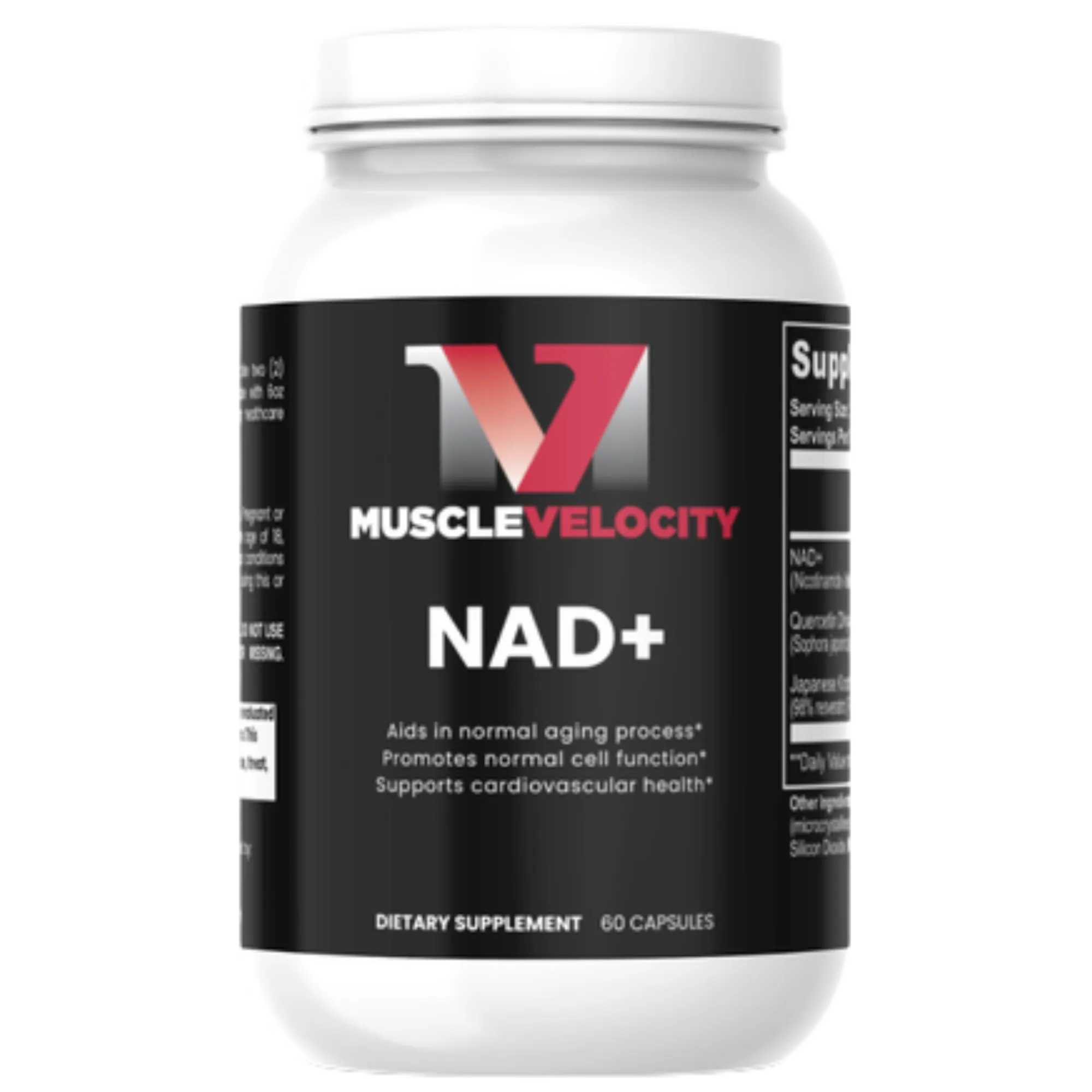
Daily cellular protocol
NAD+
500mg of NAD+ supported by Quercetin and Resveratrol, dosed once daily for cellular energy and metabolic health.
View NAD+Two precursors, one target
Both raise NAD+. The real differences are in how much human data sits behind each one and how their regulatory status has moved.
This guide is part of our NAD+ supplement guides track. For continuity, read our NAD+ precursor formula and NMN vs NAD+ supplements.
The short answer
NR and NMN are both NAD+ precursors, and human trials show both raise circulating NAD+ by broadly comparable amounts. NR has the longer and deeper human trial record, including the Martens crossover study showing roughly 60% higher NAD+ in immune cells at 1000mg/day. NMN's evidence base is newer but growing, and its US regulatory position changed materially in September 2025 when the FDA reversed its 2022 exclusion. For most buyers the deciding factors are dose transparency, third-party testing, and price per gram — not the precursor name on the front of the bottle.
Decision brief
Both compounds raise blood NAD+ in humans. Neither has demonstrated clear superiority for outcomes people care about.
NR carries the longer human trial record; NMN's evidence base is newer and expanding.
The FDA reversed its NMN exclusion in September 2025, restoring its lawful use in US supplements.
Precursor choice matters less than verified dose and third-party testing. That is where products actually differ.
Muscle Velocity standard
500mg of NAD+ with Quercetin and Resveratrol, in a stated dose. The number is on the bottle, which is the part that actually differentiates products.
Daily cellular protocol
500mg of NAD+ supported by Quercetin and Resveratrol, dosed once daily for cellular energy and metabolic health.
View NAD+Educational content only. Supplements are not a substitute for medical care. Speak with a qualified healthcare professional when a condition, medication, or persistent symptom is involved.
NAD+ is built through a salvage pathway that recycles precursor molecules. NR and NMN both enter that pathway, just at slightly different points — NR is converted to NMN, which is then converted to NAD+. That single step is the entire biochemical difference most comparison articles are arguing about.
Debates about which precursor is absorbed better generate a great deal of marketing copy and very little settled science. What human trials consistently show is that both routes end with more NAD+ in circulation, at roughly comparable magnitudes after a couple of weeks of supplementation.
If a brand tells you its precursor is categorically superior, ask which head-to-head human trial they are citing. The answer is usually a rodent study, a mechanistic diagram, or nothing at all.
NR has the more mature record. The Martens trial is the reference point: thirty adults aged 55–79, double-blind, placebo-controlled, crossover, 1000mg/day across two six-week arms, and a roughly 60% rise in NAD+ within peripheral blood mononuclear cells. It also honestly reported that blood pressure and arterial stiffness improvements did not survive statistical correction.
NMN's record is newer. A 2024 systematic review covering ten randomized trials and 437 participants at 150–1200mg/day found improvements in gait speed, six-minute walking distance, and sit-to-stand performance, alongside no significant change in grip strength or muscle mass. Its stated conclusion is a nonsignificant improvement in strength and aerobic performance, well tolerated.
Read those two paragraphs side by side and the honest summary is that neither precursor has demonstrated a decisive clinical advantage over the other. Both raise the biomarker. Both have soft outcome data. Anyone claiming otherwise is selling.
In November 2022 the FDA took the position that NMN could not be marketed as a dietary supplement, because it had previously been authorized for investigation as a drug. That pushed a number of NMN products off US shelves and made NR the safer commercial choice for several years.
That changed on 29 September 2025. In two letters, the FDA concluded there was sufficient evidence that NMN had been marketed as a supplement before the drug investigation began, and confirmed it is not excluded from the dietary supplement definition. NMN remains a New Dietary Ingredient, so premarket notification requirements still apply to manufacturers.
For a buyer, the practical upshot is that the regulatory asymmetry which used to favour NR has largely closed. Choose on dose, testing, and price rather than on which compound is currently allowed to exist.
Buying checklist
Human trials used 150–1200mg/day. A proprietary blend that hides the amount cannot be matched against any published result.
Independent testing has repeatedly found NAD+ precursor products below label claim. A certificate of analysis for your specific lot is the only meaningful answer.
Bottle prices hide wide differences in serving size. Convert to cost per gram before comparing anything.
Neither precursor has demonstrated superiority for felt energy or longevity in humans. A brand promising either has left the evidence behind.
Fit check
Common questions
Human trials do not support a clear winner. Both raise circulating NAD+ by broadly comparable amounts. NR has the longer trial record and NMN has more recent performance-outcome studies, but no head-to-head human trial has established that either produces better real-world results.
Yes. The FDA confirmed in letters dated 29 September 2025 that NMN is not excluded from the dietary supplement definition, reversing its November 2022 position. NMN is still classified as a New Dietary Ingredient, so manufacturers remain subject to premarket notification requirements.
They feed the same salvage pathway, so combining them is unlikely to do more than taking an adequate dose of either. There is no human trial demonstrating an advantage to stacking them. Spending the same money on a verified dose of one is the more defensible choice.
The Martens NR trial used 1000mg/day, split as 500mg twice daily. The NMN trials in the 2024 systematic review ranged from 150mg to 1200mg per day over four to twelve weeks. There is no established optimal dose, which is why a clearly stated amount on the label matters more than the precursor name.
Evidence desk
Continue the NAD+ guide
Precursor against precursor, and capsule against clinic.