
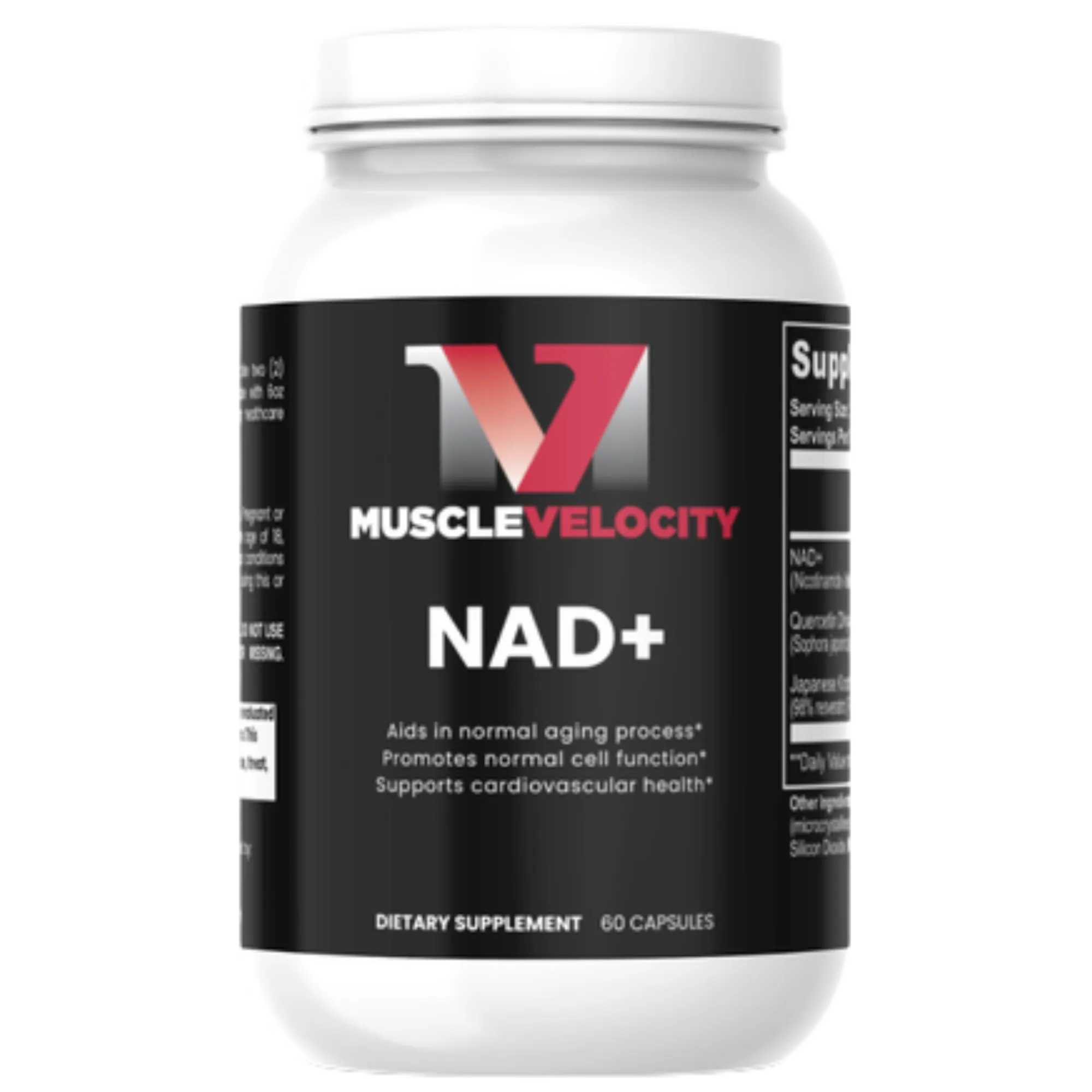
Daily cellular protocol
NAD+
500mg of NAD+ supported by Quercetin and Resveratrol, dosed once daily for cellular energy and metabolic health.
View NAD+Drip clinic or daily capsule
IV NAD+ sells on the promise of total bioavailability. The human evidence behind that promise is thinner than the price tag suggests.
This guide is part of our NAD+ supplement guides track. For continuity, read oral NAD+ without the clinic visit and NAD+ injections vs pills.
The short answer
Oral NAD+ precursors have the better-documented human evidence base, including randomized placebo-controlled trials showing roughly 60% higher NAD+ in immune cells. Intravenous NAD+ delivers the molecule directly to the bloodstream, but rigorous trials comparing it against oral precursors with intracellular NAD+ measurement are still lacking. A 2026 clinic review also found every IV NAD+ client experienced moderate to severe gastrointestinal symptoms during infusion, over an average of 97 minutes. For most people the daily oral route is the more defensible starting point.
Decision brief
IV delivery genuinely bypasses digestion. That is a pharmacokinetic fact, not proof of a better outcome.
Head-to-head trials comparing IV NAD+ with oral precursors on intracellular NAD+ are still missing.
Documented IV NAD+ infusions are slow and frequently uncomfortable — 97 minutes on average in one clinic review.
Oral precursors carry the stronger randomized evidence and cost a fraction as much per month.
Muscle Velocity standard
500mg of NAD+ with Quercetin and Resveratrol, taken daily. No appointment, no cannula, and a dose you can hold steady for the full trial period.
Daily cellular protocol
500mg of NAD+ supported by Quercetin and Resveratrol, dosed once daily for cellular energy and metabolic health.
View NAD+Educational content only. Supplements are not a substitute for medical care. Speak with a qualified healthcare professional when a condition, medication, or persistent symptom is involved.
The case for IV is straightforward. Swallow a capsule and the compound passes through digestion and first-pass liver metabolism before anything reaches your cells. Infuse it and you skip both. Delivery into the bloodstream is complete by definition.
But bioavailability is a measure of what reaches circulation, not a measure of whether you feel or function better. NAD+ is a large, charged molecule, and the question of how efficiently circulating NAD+ crosses into cells is precisely the one that has not been settled in humans.
That gap is why the honest comparison is not oral versus IV on absorption. It is oral versus IV on evidence — and on that axis the oral precursors currently have more randomized, placebo-controlled data behind them.
A 2026 retrospective review in Frontiers in Aging looked at fourteen clients at a commercial wellness clinic, six receiving 500mg of IV NAD+ and eight receiving 500mg of IV nicotinamide riboside, each over four consecutive days.
All six IV NAD+ clients reported moderate to severe symptoms during infusion — abdominal cramping, diarrhoea, nausea, vomiting, elevated heart rate, throat pain, and chest pressure. Symptoms stopped when the infusion did. Average infusion time was 97 minutes, because clients throttled their own drip rate to tolerate it. The IV NR group averaged 37 minutes with milder tingling and cramping.
The authors found no clinically significant changes in liver enzymes or inflammatory markers during infusion or at thirty days, and were explicit about the limitations: retrospective design, fourteen people, no placebo arm. It is a small window into a treatment that is marketed far more confidently than it has been studied.
An IV protocol means clinic appointments, a cannula, and one to two hours per session at a price point typically an order of magnitude above a month of oral supplementation. That is a substantial commitment to a route whose comparative advantage has not been demonstrated.
The pragmatic sequence is to start with the intervention that has randomized placebo-controlled evidence, a known dose range, and a cost you can sustain for the eight to twelve weeks the trials actually ran. If a consistent oral protocol does nothing over that period, escalating to a far more expensive route on the same mechanism is a weak bet.
None of this is medical advice about a diagnosed condition. If you are considering IV therapy for a specific health problem, that is a conversation with a qualified clinician, and it should include what the evidence does and does not support.
Buying checklist
Ask any clinic which human trials support their protocol for your goal. Mechanistic diagrams and testimonials are not trial data.
Compare a full eight to twelve week course, not a single session against a single bottle. That is the horizon the research used.
Establish whether a verified oral dose does anything for you before committing to a substantially more expensive delivery route.
A provider who does not mention that IV NAD+ commonly causes cramping and nausea during infusion is not giving you the full picture.
Fit check
Common questions
Not on current evidence. IV delivery reaches the bloodstream completely, but rigorous head-to-head trials against oral precursors measuring intracellular NAD+ are still lacking. Oral precursors have the more established randomized, placebo-controlled record.
In a 2026 retrospective clinic review, all six IV NAD+ clients reported moderate to severe symptoms during infusion, including abdominal cramping, nausea, vomiting, elevated heart rate, and chest pressure. Symptoms resolved as soon as the infusion finished. Average infusion time was 97 minutes because clients slowed their own drip rate.
Pricing varies widely by clinic and region, so we will not publish a figure we cannot verify. What is consistent is the structure: IV protocols involve repeated clinic sessions of one to two hours each, while oral protocols are a fixed monthly product cost. Compare a full eight to twelve week course on both sides.
The 2026 clinic review found no clinically significant changes in liver enzymes or inflammatory markers during infusion or at thirty days, though it studied only fourteen people with no placebo arm. Infusion-time side effects were common. Any injectable protocol should be supervised by a qualified clinician.
Evidence desk
Continue the NAD+ guide
Precursor against precursor, and capsule against clinic.