
Why the charts online disagree
Most charts copy one number from one source and drop the context. Each source measured different men, with different lab methods, for a different purpose.
The method matters more than most people expect. When Travison and colleagues pooled four large cohorts in 2017, a substantial share of the gap between them came from assay differences. Calibrating every lab to one CDC reference method closed much of it.
Your own lab report adds a third layer. The reference range printed beside your result reflects that lab's assay and the reference population it chose. Because assays differ, ranges from different labs may not line up.
- Different men: young and lean, or all ages and weights.
- Different methods: assays that are, or are not, calibrated to a reference standard.
- Different purposes: a statistical range, or a cut-off for a clinical decision.
What the guideline lines are for
The AUA guideline uses 300 ng/dL (10.4 nmol/L) as a reasonable cut-off to support a diagnosis, together with symptoms. The EAU guideline uses 12 nmol/L (about 346 ng/dL), measured fasting in the morning and repeated.
The Endocrine Society takes a different route. Its guideline relies on symptoms plus consistently low morning results, confirmed on repeat testing, rather than one fixed number. The 264 ng/dL figure often quoted beside it is the lower end of the 2017 harmonized range.
None of these lines works alone. The Endocrine Society and EAU both ask for symptoms and a repeat test before the word deficiency is used; the AUA pairs its cut-off with symptoms.
What age changes
Younger men have been judged against a 300 ng/dL cut-off that was built from samples of older men. Zhu and colleagues tested that in 2022 using morning values from 1,486 US men aged 20 to 44.
Their age-specific lines run from 413 ng/dL for ages 25 to 29 down to 350 ng/dL for ages 40 to 44. In other words, a result that clears 300 can still sit in the bottom third for a man in his twenties.
After 40, the decline is gradual. In the Massachusetts Male Aging Study, total testosterone fell about 0.8% per year of age across men aged 40 to 70, and free testosterone fell faster, about 2% per year. Men in good health, with no chronic illness, obesity, or heavy drinking, ran 10 to 15% higher on several androgens.
Verified age bands stop at 44 in these sources. Any chart that lists a tidy range for every decade past that is filling gaps the research has not filled.
How to read your own number
Check the unit first. Labs report total testosterone in ng/dL or nmol/L. Multiply nmol/L by 28.84 to get ng/dL.
Then check how the sample was taken. The Endocrine Society and EAU ask for a morning, fasting draw. If yours was an afternoon draw, or after breakfast, it can read low for reasons that have nothing to do with your baseline.
A single result is not a diagnosis. Take it, with your symptoms, to a clinician, and expect a repeat morning test before any decision.
Lab checklist
What to check before you compare
The unit
ng/dL or nmol/L. 12 nmol/L is about 346 ng/dL. Compare like with like.
The time of the draw
The Endocrine Society and EAU ask for a morning sample. An afternoon result can read low.
Fasting or not
The EAU and Endocrine Society both ask for a fasting sample.
Your lab's reference range
It reflects that lab's assay and reference population, not a universal norm.
Whether it was repeated
The Endocrine Society and EAU want a second morning result before calling a level low.
Fit check
Who this guide is—and is not—for
Good fit
- Men holding a lab result and trying to make sense of it.
- Men who found three different normal ranges online and want to know why.
- Men in their twenties and thirties who were told 300 ng/dL is the only line that matters.
Poor fit
- Anyone looking for a number that diagnoses them. That takes symptoms, a repeat test, and a clinician.
- Men already on testosterone therapy, whose target ranges are set by their prescriber.
Common questions
The questions worth answering
What is a normal testosterone level for a man?
There is no single number. In healthy, non-obese men aged 19 to 39, a 2017 harmonized analysis put the range at 264 to 916 ng/dL. Guidelines draw their cut-offs at 300 ng/dL (AUA) or 12 nmol/L, about 346 ng/dL (EAU), and always pair them with symptoms.
What is a normal testosterone level at 30?
In a 2022 study of US men, the middle third of morning values for ages 30 to 34 ran from 359 to 498 ng/dL. The authors used 359 ng/dL as the age-specific line for low. That is a research cut-off, not a diagnosis.
Does testosterone drop with age?
Gradually. In men aged 40 to 70 in the Massachusetts Male Aging Study, total testosterone fell about 0.8% per year of age and free testosterone about 2% per year. Good general health was linked to levels 10 to 15% higher.
Is 300 ng/dL low testosterone?
The AUA guideline uses 300 ng/dL (10.4 nmol/L) as a cut-off, together with symptoms. The Endocrine Society and EAU also want a repeat morning test. Other lines sit higher: 12 nmol/L in the EAU guideline, and 350 to 413 ng/dL for men aged 20 to 44 in a 2022 study. One result is not a diagnosis; read it with your clinician.
Muscle Velocity standard
Know your numbers. Read them with a clinician.
Get the morning test and read it with your clinician. If you also want a daily NAD+ protocol for cellular energy, see what is in ours.
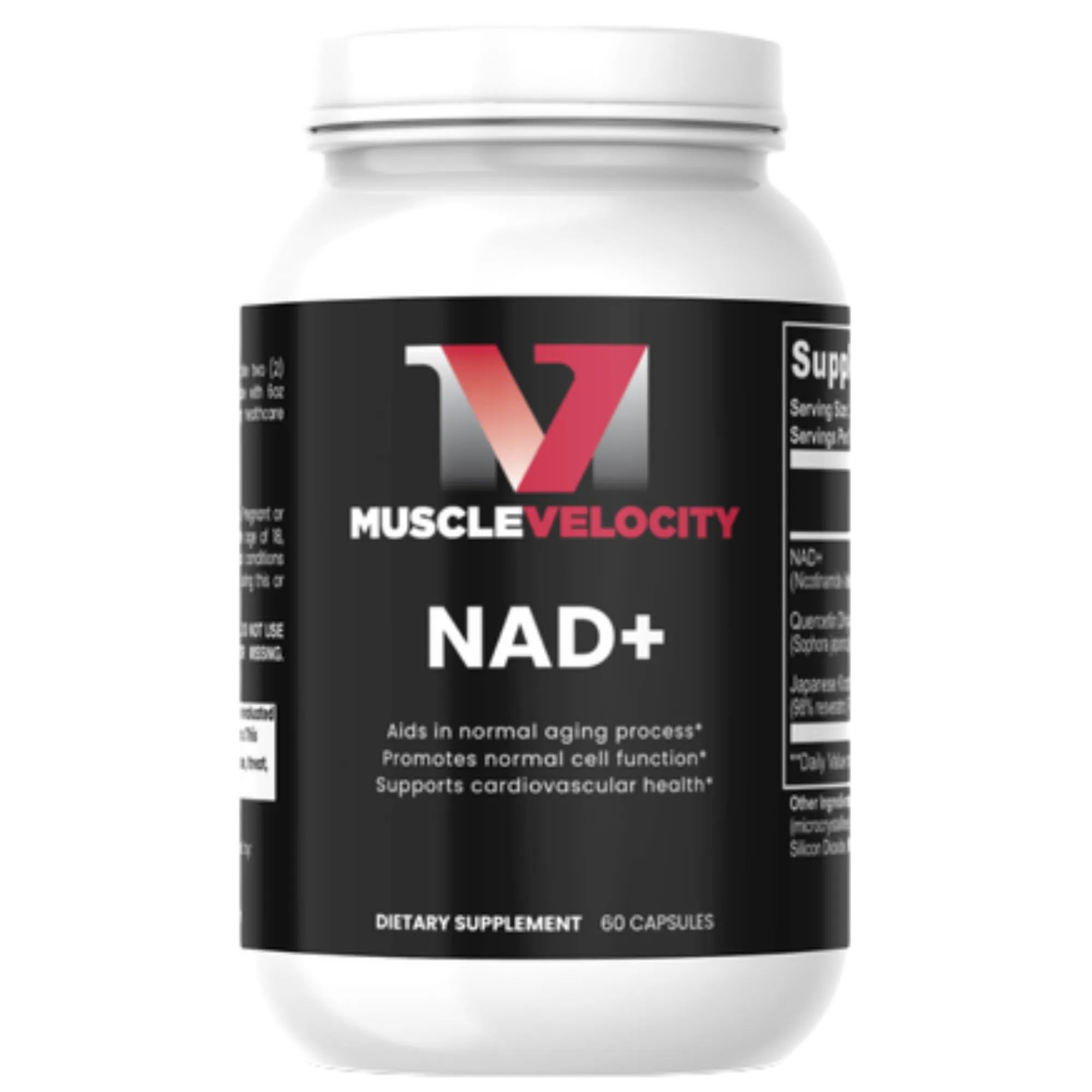
Daily cellular protocol
NAD+
500mg of NAD+ supported by Quercetin and Resveratrol, dosed once daily for cellular energy and metabolic health.
View NAD+Educational content only. A lab result is not a diagnosis, and supplements are not a substitute for medical care. Speak with a qualified healthcare professional about symptoms, results, or medication.
Evidence desk