
Why 45 feels flat for almost everyone
If you feel flat in your mid-40s, you are in large company. Blanchflower and Oswald analyzed data from 500,000 randomly sampled Americans and West Europeans. A typical person's happiness reached its lowest point in middle age, for men and women. The same U-shape showed up in 72 nations, and in depression and anxiety reports from 1 million UK citizens.
So the midlife dip is real, and it is not a personal failure. It is also not a diagnosis. "Midlife crisis" is a cultural label, not a medical condition.
At the same time, testosterone does fall with age. In the Massachusetts Male Aging Study, 1,156 men aged 40 to 70 were followed for 7 to 10 years. Within the same men over time, total testosterone fell about 1.6% per year.
Put those two facts together and a man of 45 can have a normal midlife dip, genuinely low testosterone, or both at once. That is why guessing is a bad strategy.
The 3 symptoms that point to low testosterone
This is the most useful finding on this page. The European Male Aging Study looked at 3,369 men aged 40 to 79 across eight European centers, measuring morning testosterone with mass spectrometry.
Fatigue, low mood, and low physical vigor were each related to testosterone level. But only three symptoms clustered with low testosterone as a syndrome: poor morning erections, low sexual desire, and erectile dysfunction.
That means feeling tired and flat, on its own, is weak evidence of low testosterone. Those feelings have many possible causes, including the normal midlife dip. The sexual symptoms are the signal that carries real weight.
The study defined late-onset hypogonadism as at least three sexual symptoms plus total testosterone under 11 nmol/L (about 317 ng/dL, our conversion) and free testosterone under 220 pmol/L. Symptoms and bloodwork, together. Neither one alone is enough.
Low T or midlife dip: a side-by-side check
This is a pattern guide, not a diagnosis. Use it to decide what to do next, then talk to your doctor.
Points to low testosterone: fewer morning erections than you used to have, noticeably low sexual desire, erectile dysfunction, and several of these showing up together rather than one bad week.
Points to a midlife dip: low mood or a sense that meaning has drained out of work and hobbies, fatigue with normal sexual function, and a slow slide that lines up with big life changes, such as a career plateau, kids leaving home, or aging parents.
If your main problem is mood, meaning, or drive with normal sexual function, low testosterone is a less likely sole cause. If the three sexual symptoms are present, a test is a strong next step. Either way, the bloodwork settles it.
How to find out for sure
Guessing can go wrong both ways. A man with a normal midlife dip may spend money on products he does not need. A man with genuinely low testosterone may wait years for an answer.
The Endocrine Society guideline is specific. Diagnose low testosterone only in men with symptoms plus unequivocally and consistently low testosterone. Measure fasting morning total testosterone with an accurate assay, then confirm it with a second fasting morning test. The American Urological Association guideline also ties assessment to total testosterone together with symptoms and signs.
Why two tests? Because one reading can be off. A single week of short sleep moved testosterone 10% to 15% in one study. One low result is a data point. Two consistently low morning results, alongside symptoms, is a pattern.
What testosterone treatment does not fix
Say you do test low and your doctor raises treatment. Know what the evidence says it changes, because expectations drive disappointment.
The Testosterone Trials followed 790 men aged 65 or older with testosterone under 275 ng/dL plus symptoms, on testosterone gel or placebo for one year. Testosterone improved sexual activity, desire, and erectile function. It did not significantly improve vitality on a fatigue scale. Mood was slightly better and depressive symptoms slightly lower than on placebo.
A separate analysis pooled 27 placebo-controlled trials covering 1,890 men. Testosterone treatment was linked to a significant but small drop in depressive symptoms, and the authors called for more trials with depression as the main outcome.
The honest summary: in older men with low levels, treatment improved sexual function, helped mood a little, and did not improve energy. "TRT will give me my drive back" is not a safe expectation, especially if the real problem is not hormonal.
The two levers you control: sleep and body weight
Whatever the bloodwork says, two inputs are yours to move, and both have numbers behind them.
Sleep. In young healthy men, one week of sleep restricted to 5 hours a night lowered daytime testosterone by 10% to 15%. The authors note that at least 15% of the US working population sleeps this little, and that normal aging lowers testosterone by 1% to 2% per year. One week of short sleep caused a bigger drop than several years of normal aging.
Body weight. In the European Male Aging Study of 3,200 men aged 40 to 79, a BMI of 25 to under 30, and of 30 or more, was linked to lower total and free testosterone. In the Massachusetts Male Aging Study, good health (no chronic illness, prescription medication, obesity, or heavy drinking) added 10% to 15% to several androgen levels.
One caution: these studies measured testosterone, not mood. Better sleep and a healthier weight support your hormonal baseline. They are not a proven fix for a midlife mood dip.
When it is not your hormones
If your bloodwork comes back normal and the flatness stays, that is not a dead end. It points you at the real question.
The midlife dip is often about purpose, not chemistry. Work that stopped growing. A body that no longer does what it did at 30. An identity built on a stage of life that ended. Those are real problems, and they respond to real answers: new challenges, honest conversations, and a doctor or therapist who helps you sort what you want now from what you chased at 30.
Strength includes asking for help. The lone-wolf act is a fast track to burnout, and talking to a professional is a leadership move, not a weakness. Work on the dip like a project, not something to hide.
If you are having thoughts of harming yourself, call or text 988 (US) or your local emergency number now.
Lab checklist
Signs it is worth getting tested
You have the three sexual symptoms
Fewer morning erections, low sexual desire, or erectile dysfunction, especially when more than one shows up together.
Your fatigue comes with those symptoms
Tiredness alone is weak evidence, but fatigue on top of sexual symptoms is a pattern worth testing.
One test already came back low
A single result is not a diagnosis. The Endocrine Society calls for a second fasting morning test to confirm it.
You are thinking about any treatment
Boosters, clinics, or prescriptions: two morning blood tests come first, so you know what you are treating.
Fit check
Who this guide is (and is not) for
Good fit
- Men 38 to 55 who feel flat, low on drive, or less interested in things they used to enjoy, and want to know if hormones are involved.
- Men with one or more of the three sexual symptoms tied to low testosterone.
- Men weighing a booster or a TRT clinic who want bloodwork before they spend anything.
Poor fit
- Anyone having thoughts of self-harm. Call or text 988 (US) or your local emergency number now.
- Men already diagnosed and on treatment under a doctor's care. This page is about the decision before diagnosis.
- Anyone looking for a quiz that gives a verdict. Only bloodwork and a doctor can do that.
Common questions
The questions worth answering
Can low testosterone cause a midlife crisis?
The research we reviewed does not link the two directly. "Midlife crisis" is not a medical condition, and happiness dips in middle age for men and women across 72 nations. Testosterone does fall with age, but only three sexual symptoms clustered with low testosterone in a study of 3,369 men.
Can low testosterone cause depression?
Low mood was related to testosterone level in the European Male Aging Study, but it did not cluster with low testosterone the way sexual symptoms did. A meta-analysis of 27 trials found a small drop in depressive symptoms on testosterone. If low mood is your main symptom, talk to a doctor first.
What age does testosterone start dropping?
The best long-term data covers men 40 and up. In the Massachusetts Male Aging Study, total testosterone fell about 1.6% per year within the same men over 7 to 10 years. When the decline starts varies from man to man, which is one more reason to test rather than assume.
Will TRT fix my low energy?
The best trial so far says probably not. In the Testosterone Trials, 790 men aged 65 or older with low testosterone used gel or placebo for a year. Sexual function improved and mood improved slightly, but vitality on a fatigue scale did not significantly change.
Should I try a testosterone booster first?
Not before you test. A booster skips the step that matters: finding out whether your testosterone is actually low. Fatigue and low mood have many causes in midlife. Get two fasting morning blood tests plus a symptom review with your doctor first.
Muscle Velocity standard
Know your numbers. Read them with a clinician.
Get tested, read the results with a clinician, and work the inputs you control. If you also want a daily NAD+ protocol for cellular energy, see what is in ours.
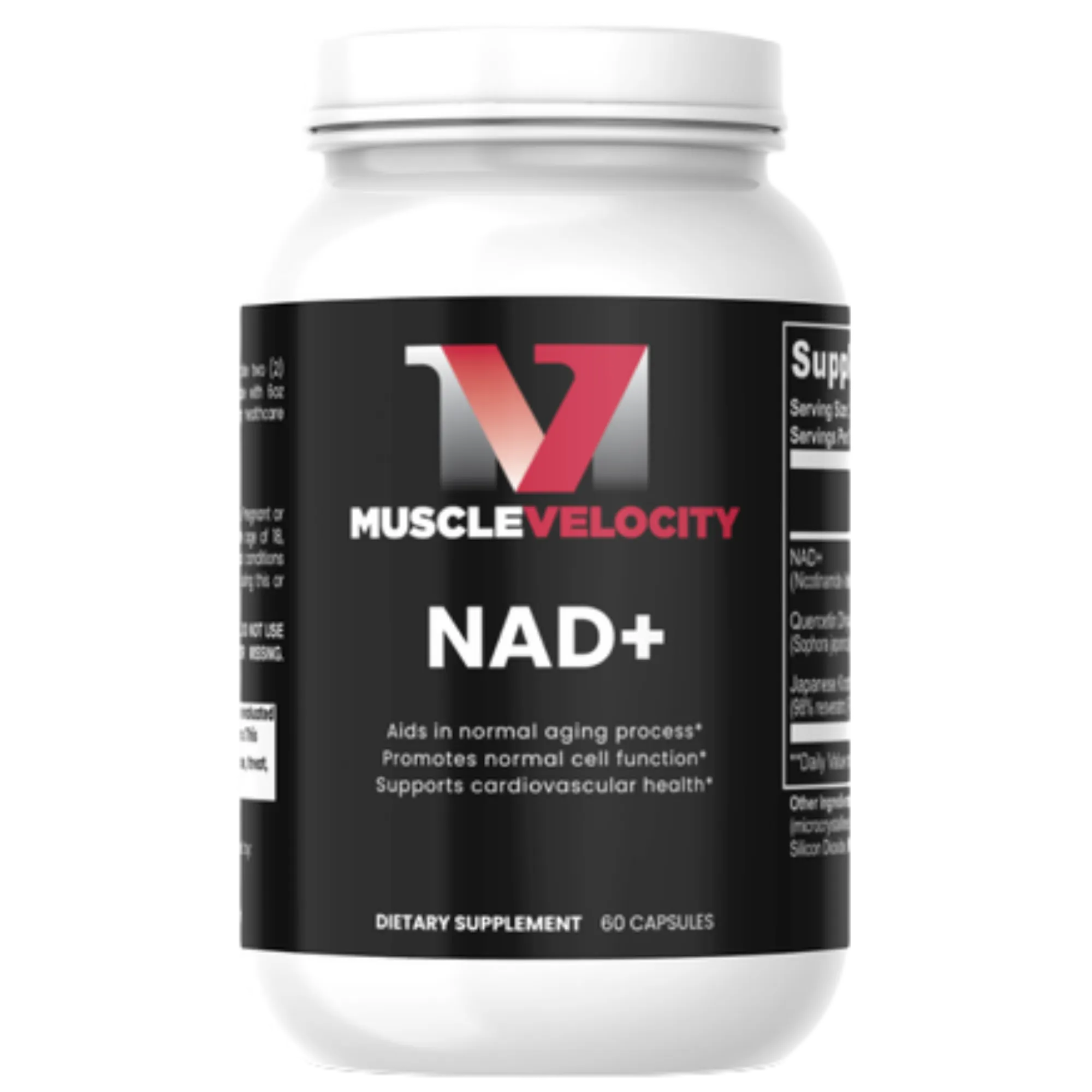
Daily cellular protocol
NAD+
500mg of NAD+ supported by Quercetin and Resveratrol, dosed once daily for cellular energy and metabolic health.
View NAD+Educational content only. A lab result is not a diagnosis, and supplements are not a substitute for medical care. Speak with a qualified healthcare professional about symptoms, results, or medication.
Evidence desk